Take Care of Yourself

Valerie studies at a big university. At the same time, she maintains a full-time job so that she can pay for her tuition and her living expenses. So Valerie spends most of the day at the office, then goes to class three days a week. She also stays up late at night to study for her classes.

Valerie does not do any physical exercise. Between work and university, she is so busy that she thinks she does not have time for any physical activity.

Sadly, she rarely eats home-made meals. She usually just grabs a bag of chips or a hamburger as she leaves her office to take the bus to university. Since she is convinced that she does not have time to make a healthy dinner when she gets home, she eats lots of pizzas that she orders over the phone.

After dinner, she starts studying and preparing her assignments. Valerie does not sleep very much because of it. She feels grumpy when she wakes up early in the morning, and she is irritable at work. After her long day, she feels tired in class, and it is hard for her to concentrate.

To make matters even worse, Valerie keeps getting sick. This makes her miss work and class. She is miserable! She just wants to feel good. Her grades start to go down because of her illnesses. As she thinks about her whole life situation, she gets so frustrated that she does not even want to study anymore.

During her mid-year break, Valerie decides to make some big changes. First, she learns how to make some easy, healthy recipes. She actually finds that she saves a lot of money by preparing her food herself, and the food tastes much better too! After an early dinner and some quiet reading, Valerie goes to bed early every night. Now she really feels refreshed in the morning.

Then she decides to give something else a try. Her office is not really so far from her university, so one day after work she tries walking there. As she walks down the street, looking at all the people, the shops, and the movement in the city, she remembers how much she hates being stuck on the bus in traffic. In fact, she finds that she can get to class almost as fast by walking. And she is so much happier when she arrives!

When the semester begins, Valerie maintains her healthy habits. She sets time aside on the weekends to study and do her assignments. Because she is sleeping and eating better now, she can finally concentrate and needs to spend much less time studying.

It is a huge improvement. Valerie saves money on food and transportation, she has much more energy, she feels less stressed, and her grades are better. She is glad she finally started to take care of herself. Now she finally enjoys all of her different activities and feels happy about her life.

And now, practice:

Exercises

Vocabulary Questions

1. What does “tuition” mean?

a) the money you pay to live in an apartment

b) the money someone pays you to work for them

c) the money you pay to a university to study there

d) the money a university gives you to help you study

2. What does “grumpy” mean?

a) upset and irritable

b) confused

c) energetic

d) tired

3. What does “healthy” mean?

a) good for your body

b) good for your emotional state

c) good for your mental state

d) all of the above


Grammar Questions

1. She decides ________ to class.

a) to walk

b) walking

c) walk

d) walked

2. Valerie keeps ________ sick.

a) having

b) getting

c) being

d) doing

3. She is so much ________ when she arrives.

a) happy

b) happiest

c) more happy

d) happier


Comprehension Questions

1. Why does Valerie always feel frustrated and irritable? Because she was sick, and she did not go to her classes and her marks fall.
2. What healthy changes does Valerie make in her life? She improved her food, she gave up ordering fast food and she began doing exercises.

English

Famous Women in History

In this lesson, students choose a woman they feel contributed something important to society and then create a presentation about her and the contribution. A variety of choices are offered …

Test

Choose from the following prepositions at, by, for, from, in, on, with and complete the sentences.

  1. Where do you come  from   ?
  2. My cousin lives  in   Norway.
  3. They are walking on the bridge.
  4. I don’t like flying, so I went to Paris by bus.
  5. You can stay  with  me tonight.
  6. My birthday is on  29th February.
  7. I’ll see you at  Christmas.
  8. Put the books on the table, please.
  9. I haven’t seen you for ages.
  10. I like this house by   the river.

Use the verbs in brackets to complete the sentences. Use the correct tense.


When I was looking out of the window, I saw John. Have you ever played the piano since you left school? I have not seen him for two days. When he was trying to open the door, he dropped his key. They have lived in this house since 1987. My father was washing his car while my mother and I were preparing dinner. Did you meet her yesterday? Mary has been in London for three days. The headmaster entered the classroom when they were writing their exams. He bought a new car last week. I think that they will arrive tomorrow morning. Last Wednesday they played chess after they had done their homework.

Choose the correct pronouns to complete the sentences.

1. The old woman lived alone, with —- to look after —-.

A) someone / her
B) anyone / herself
C) everyone / she
D) no one / her
E) anyone / she’s
2. —- two rings here on my little finger belonged to —- grandmother.

A) These / my
B) That / mine
C) Those / me
D) The / myself
E) This / my
3. When the little boy grabbed the lizard, —- tail broke off in —- hand.

A) it’s / his
B) it / him
C) its / his
D) it / one’s
E) its / he’s

4. A baby learns the meaning of words as —- are spoken by others and later uses —- in sentences.

A) their / they
B) they / them
C) they / themselves
D) it / them
E) they / it
5. Some of these clothes are —-, and the rest of —- belong to Zack.

A) yours / it
B) my / them
C) hers / their
D) me / they
E) mine / them

6. As for —-, I prefer to let people make up —- minds.

A) myself / each other’s
B) I / his own
C) mine / one another’s
D) me / their own
E) my / theirs
7. The solicitor wrote a letter to Ann and —- in which he asked us if we could settle the matter between —-.

A) I / us
B) me / us
C) myself / ours
D) mine / our
E) me / we
8. As —- cuts it as well as he does, I always have my hair cut at Johnson’s.

A) anyone
B) someone else’s
C) no one else
D) everyone
E) nobody’s
9. They decided to buy the house because —- location would allow —- to get to work very easily.

A) theirs / them
B) it / themselves
C) its / them
D) they / us
E) its / their
10. Our dog is of a very good breed as —- is the offspring of two very champion dogs and inherited —- features.

A) this / its
B) he / them
C) she / theirs
D) that / his
E) it / their

 Complete the following exercise with adjective or adverb form of the words.

That pitbull looks angrily. (angry) She spoke quietly. (quiet) Erica listened to her mother carefully. (careful) Mary makes careless mistakes. (careless) Children grow quickly. (quick) He is very happy today. (happy) It’s raining heavily. (heavy) Morgan was seriously hurt in a car accident. (serious) His situation was very serious. (serious)

Unusual Hotel

lovers Deep luxury submarine hotel

The underwater hotel called “Lovers Deep” can be moored near the coastal reef off the coast of St. Lucia or near a sunken battleship in the Red Sea.

But love at the bottom of the ocean doesn’t come cheap. You’ll need to cough up £175,000 per night in order to board the submarine vessel.

luxury submarine bedroom

Guests get a captain, a private chef and butler, speedboat transfers and optional add-ons that include helicopter transfers, beach landing, two-person shower, and champagne-soaked breakfast.

luxury submarine lounge

english

The river of words

by Donald Bisset

Once upon a time there was a river which was made of words. It flowed (հոսում էր) down to the sea and the sea was made of story books.

As the river flowed along, the words and the letters tumbled over each (գլուխկոնծի էին տալիս) other and hit the rocks just like ordinary rivers.

“I know,” said the river. “Let’s write a story! Once upon a time…”

“Hooray!” shouted all the other words. “That’s the way to begin a story. Now what comes next?”

This is the story the river told them.

Once upon a time there was a river made of words and it was going down to the sea and all the words were going into story books, when suddenly a little otter (ջրասամույր) swam across the river and the words got into the wrong order so that instead of writing “Once upon a time’ it wrote “on at Once up time” and it got in a frightful muddle.

“Oh, you are a naughty otter,” the river said to the otter whose name was Charlie. “Now you’ve spoilt our story.”

“I’m terribly sorry!” said Charlie. “Perhaps if I swim back again it’ll put things right.”

He swam back and then clambered on the bank and looked at the words, “time upon a Once”, he read. “Surely that’s not right!”

However the river swirled about a bit and soon got it right. “Once upon a time,” he read, “there was an otter who is name was Charlie.”

“Why that’s me! My name’s Charlie. It’s a story about me!” He got so excited and jumped up and down and then slipped and fell in the river and jumbled up the words again. Oh, the river was annoyed!

The otter got out as quickly as he could and looked at the words: “otter was Charlie time upon a Once.” Worse and worse!

“What do you expect?” said the river. “Every time we start you fall in and get it all jumbled. Now we’ve got to start all over again.”

“Once upon a time there was an otter whose name was Charlie and he lived by the river of words… Now what happens next?“

They thought and thought but couldn’t think of a story about Charlie. So he said, “I’ll help,” and got back from the river and then ran as fast as he  could and jumped right into the middle of the river. Then he swam and looked at the words. (He’d jumbled them right, this time.)

“Once upon a time there was a very naughty otter,” he read, “and one day he met a pussy-cat.”

“Mieow!” said the pussycat. “Do you like ice-cream?”

“No!” said Charlie.

“Mieow! Do you like milk?”

“No!”

“Mieow! Do you like fish?”

“Yes, I do!” said Charlie.

“Mieow,” said the pussycat. “Well, if you come to my house my aunt will give you a fish tea. Brown bread and butter and fish paste.”

“That will be nice!” said Charlie. “It makes me feel quite hungry. I think I’ll go home to tea now. But before I go tell me, what are you going to do with the story?”

“It’s going to be a story in a book called Time and Again Stories,” said the river.

Charlie was pleased. “That’s nice!” he said. “Now I’m going! Good-bye!”

“Good-bye!” said the river.

The words all jumbled around and then spelt “Love and kisses to Charlie.” And tumbling and tossing they flowed on into the storybook sea

Unknown words

flow down- ներքև հոսել

flow along-երկայնքով հոսել

to tumble-գլորվել, գլուխկոնծի տալ

to shout- բղավել

to shut- փակել

otter-ջրասամույր

to be pleased- գոհ լինել

naughty-չարաճճի

frightful-սարսափելի

muddle-խառնաշփոթ

English

Fill in the present or past tense.
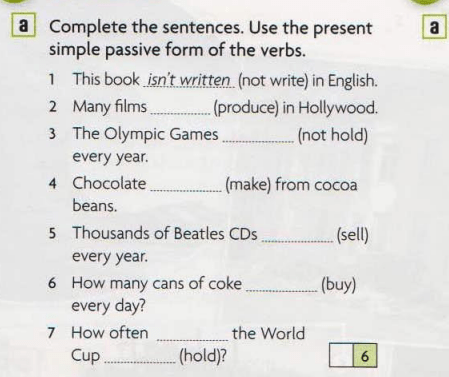
1. He  was offered (offer) a new job last week.
2. The bridge blew up (blow up) yesterday.
3. This novel was written (write) by Hemingway.
4. Flies  are caught (catch) by spiders.
5. All the trees  were cut (cut) down yesterday.
6. We  are told (tell) to go home now.
7. Their purse  was stolen (steal) in the disco last night.
8. Rain  is held (hold) up by fog.
9. He was thrown (throw) out of the bar a week ago.
10. Pigs are used (use) to find truffles.
11. The old theatre was reopened (reopen) last Friday.
12. She was asked (ask) about the accident by the police yesterday.
13. A lot of food  is thrown (throw) away every day.
14. Mice  are caught (catch) by cats.
15. I am often ask (often / ask) for her address.

1. Millions of dollars’ worth of damage has been caused by a storm which (swept/was swept) across the north of the United States last night.

2. The River Reiner  (burst/was burst) its banks after heavy rain.

3. Many people  (rescued/were rescued) from the floods by fire-fighters.

4. Firefighters  (received/were received) hundreds of calls for help.

5. Wind speeds  (reached/were reached) ninety miles an hour in some places.

6. Roads  (blocked/were blocked) by fallen trees.

7. Electricity lines  (brought/were brought) down, leaving thousands of homes without electricity.

8. “Everything possible  (is doing/is being done) to get things back to normal,” a spokesman said.

9. One young girl  (took/was taken) to hospital after she broke her leg.

10. She has now  (sent/been sent) home.

1. They were interviewing her for the job.
She ________________ for the job.
  was being interviewed
  was interviewed
  has been interviewed

2. Tom is writing the letter.
The letter ________________ by Tom.
  was written
  is being written
  has been written

3. Everyone understands English.
English ________________ by everyone.
  is understood
  has been understood
  was understood

4. The employees brought up this issue during the meeting.
This issue ________________ by the employees during the meeting.
  has been brought up
  is brought up
  was brought up

5. The professor told him not to talk in class.
He ________________ by the professor not to talk in class.
  has been told
  was told
  was being told

6. They say that women are smarter than men.
Women ________________ to be smarter than men.
  were being said
  were said
  are said

English

Rewrite the sentences in passive voice.

  1. She sang a song. – A song was sang by her.
  2. Somebody hit me. – I was hit by somebody.
  3. We stopped the bus. – The bus was stopped by us.
  4. A thief stole my car. – My car was stolen by a thief.
  5. They didn’t let him go. – He was not let go by them.
  6. She didn’t win the prize. – The prize was not won by her.
  7. They didn’t make their beds. – Their beds were not made by them.
  8. I did not tell them. – They were not told by me.
  9. Did you tell them? – Were they told by you?
  10. Did he send the letter? – Was the letter sent by him?

Fill in the verb in the Past Active or Passive Voice.

What artist … (painted / was painted) this picture?

Elective lessons

A
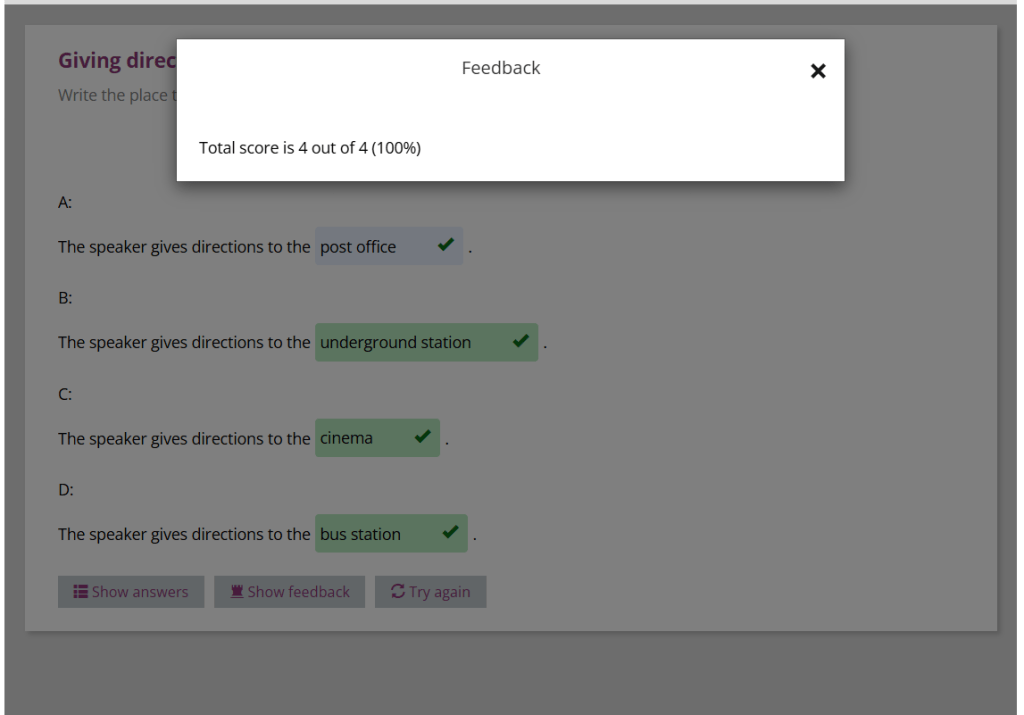
Go straight on. Then take the first left on to Green Street. Walk past the library and it’s the building next to the library on the left.

B
Go straight on. Go past the traffic lights. You will see a shop on the right. Go past that and it’s on the right next to the shop.

C
Go straight on. Go past the traffic lights and go straight on until you get to the roundabout. At the roundabout turn left. Go past the theatre. It’s the building next to the theatre, opposite the hospital.

D
Go straight on. Go past the traffic lights and take the second right on to King’s Road. Go past the bookshop. It’s the building next to the bookshop opposite the cafe.

unknown words

traffic lights-լուսացույց

traffic jam-խցանում

go straight on-գնա ուղիղ

roundabout-շրջանաձև երթևեկություն

tasks

task 2.

task 3.

English

  • Are you humorous? Yes I am humorous, but not often.
  • Can you tell about a time when you were very funny? I am funny when, I am winning more stronger chess player than me or when I am do chess and mor.
  • What kind of humor do you like? Do you like many kinds? I like humors in every kind, but not like embarasing humors.
  • Why do people say laughter is the best medicine? Because laugh is the most funniest thing ever, and when people was laughing they are forgetting about their worries.
  • Can you tell about a time when you laughed at yourself? No I am don’t laugh at myself, but often I am laughing for nothing and I can’t stop my laugh.
  • What type of humor do you like? I like simple humors.
  • Do you like to tell jokes? Yes, every child likes to do jokes.
  • Are you a good joke teller? Maybe it can say my friends.
  • What sort of things make you laugh? I can laugh from everything.
  • How frequently do you laugh every day? Maybe I am laughing every day.
  • Do you laugh out loud or do you chuckle quietly? I am laughing loud.
  • Do you sometimes laugh in situations which are not amusing? Yes.
  • Laughter is catching. Do you start laughing when you see or hear other people laughing? Why do you think this happens? I don’t know but this happens with me very often or every time.
  • What is the difference between “laughing at someone” and “laughing with someone”? The difference is that if you laugh at, for example to your friend, it’s not good job, but if you laugh at something else, its is different.
  • Does your language have equivalent expressions for
    • “I nearly died laughing!” or “I cracked up (with laughter)!”?
    • “He was the laughing stock”
    • “Don’t make me laugh!”
  • Yes I can equivalent that expressions into my language.
  • «Քիչ էր մնում մեռնեի ծիծաղից»: կամ «Ես մի կերպ պահեցի (ծիծաղս)»: –
  • «Նա ծիծաղի առարկա է»
  • «Մի՛ ծիծաղացրու ինձ»:

English

December 16-20

A New Year․ A New Start

Think about your New Year’s resolutions and your happiest memories of the past year.  Consider short-term and long-term goals and think about the paths you can take to make your dreams come true. How can you improve your life in the new year? If you could have a New Year’s wish, what would it be? What are you the most excited for in the coming year? If you could celebrate the new year from anywhere in the world, where would you go? Why?

History of New Year Celebrations Around the World

What is New Year’s Eve? New Year’s Eve is one of the biggest occasions in the calendar year for most places in the world, which means there’s a fascinating history surrounding how it’s celebrated, stretching back to the start of recorded history.

There are also multiple ways people celebrate the new year, whether it be fireworks in a city through our modern-day era or Spain’s tradition for people to stay at home, at least until 12 o’clock, and they like to see in the New Year by eating 12 grapes at the stroke of midnight. No matter the way of celebrating the new year, there is something different, but also something unique about it.

Ancient Babylon

The Babylonians were the first people to celebrate New Year in some shape or form. We don’t know a lot about what they did, but maybe they had a big party at the Hanging Gardens of Babylon?

The earliest record of a New Year’s celebration comes over 4,000 years ago from the ancient Babylonians. They didn’t celebrate New Year at the same time we do, though. Instead, the New Year was marked by a big celebration at the spring equinox. To the rest of us, that’s the point of the year when the days start to become longer than the nights. Because they lived in the Northern Hemisphere, this was usually some point in late March.

The Babylonians knew how to party. In fact, they celebrated the New Year with an 11-day festival, which involved a different ritual on each day. Not too much is known about this, but what we do know is pretty exciting. The festival was called Akitu, and it celebrated a victory of the sky god, Marduk, over the evil sea goddess, Tiamat.

The Romans

The Romans were the first people to celebrate New Year’s Day on 1st January, thanks to a certain Julius Caesar.

Though we might think of the Romans as belonging to ancient history, they cropped up a whopping 1,500 years after the earliest traces of Babylonia! Anyway, they loved a good New Year’s party too. They were also the first people to celebrate New Year’s Day when we do, on 1st January.

There’s a good reason for this. The Roman calendar was originally aligned with the sun, but over time, it fell out of sync. So, to bring it back up to speed, Caesar added 90 days! This is the equivalent of roughly two extra months. As part of this, it was decided that each year would start at the beginning of Janus, after the god of new beginnings.

The Middle Ages

The start of the New Year changed again in the Middle Ages, but it didn’t stay like this for long.

In Christian, medieval Europe, the leaders of the Church didn’t like the idea of the New Year being celebrated on a Roman feast day, so they played around with the dates a little. At first, they changed the start of the year to the 25th of December, and then, deciding that Christmas is best left alone, to the 25th of March. Eventually, Pope Gregory XIII realised that there was nothing wrong with the old way of celebrating New Year, so he changed the date back to the 1st of January, in 1582.

And there you have it, a short history of New Year celebrations around the world! If you’d like to learn more about how the big day is celebrated in the 21st century, then you might want to keep on reading…

New Year Celebrations Around the World Today

Spain

Spain has the tastiest way to celebrate New Year’s Eve, that is if you like grapes!

In Spain and a few other Spanish-speaking countries, New Year’s Eve is known as Noche Vieja. It’s traditional for people to stay at home, at least until 12 o’clock, and they like to see in the New Year by eating 12 grapes at the stroke of midnight. This symbolises their hopes and dreams for the year to come. It also sounds pretty tasty too… There are big parties in a lot of towns across the country, but the most famous one is in Madrid, in the Puerta del Sol.

Italy

Over in Italy, New Year’s Eve is known as La Festa di San Silvestro, that is, the feast day of Saint Sylvestre. Like a lot of countries around the world, families gather for a meal, which usually features pork and lentils. After the meal, it’s time to head to the streets for a big ol’ party. If you’re lucky enough to find yourself in a big city like Rome, Milan or Naples, then you can expect to see a big fireworks show.

Oh, and don’t forget to wear red underwear! Some people in Italy believe that wearing red underwear on New Year’s Eve can bring you good luck. You’ll see loads for sale at the December markets!

USA

Times Square is home to what’s probably the world’s most famous New Year’s Eve party.

In the US, New Year’s Eve is celebrated in much the same way as it is here in Australia. That is, families get together for a special meal, and there’s a whole load of fireworks. New York is home to the world’s most famous New Year’s celebration. Each year, thousands of party-goers gather in Manhattan to see the famous Times Square Ball (pictured above) being lowered at the stroke of midnight. The ball itself is made of Waterford Crystal, which is a kind of patterned glass, so let’s hope no one ever drops it!

China

In China, and a few other countries in South East Asia, New Year is celebrated at the start of the lunar calendar, which, in 2022, falls on the 1st of February. The festival lasts for over two weeks, ending with the traditional Lantern Festival. Because there are big Chinese and Asian communities in a lot of countries around the world, most cities will have some kind of Chinese New Year celebration, so you don’t have to worry about missing out on the fun.