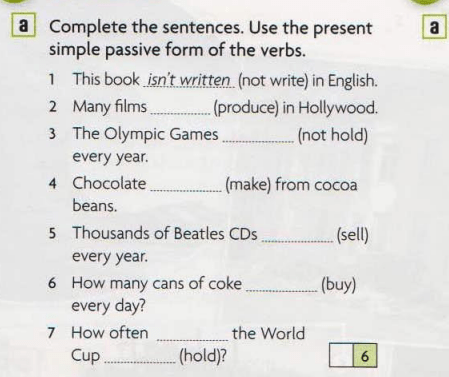
Fill in the present or past tense. 1. He was offered (offer) a new job last week. 2. The bridge blew up (blow up) yesterday. 3. This novel was written (write) by Hemingway. 4. Flies are caught (catch) by spiders. 5. All the trees were cut (cut) down yesterday. 6. We are told (tell) to go home now. 7. Their purse was stolen (steal) in the disco last night. 8. Rain is held (hold) up by fog. 9. He was thrown (throw) out of the bar a week ago. 10. Pigs are used (use) to find truffles. 11. The old theatre was reopened (reopen) last Friday. 12. She was asked (ask) about the accident by the police yesterday. 13. A lot of food is thrown (throw) away every day. 14. Mice are caught (catch) by cats. 15. I am often ask (often / ask) for her address.
1. Millions of dollars’ worth of damage has been caused by a storm which (swept/was swept) across the north of the United States last night.
2. The River Reiner (burst/was burst) its banks after heavy rain.
3. Many people (rescued/were rescued) from the floods by fire-fighters.
4. Firefighters (received/were received) hundreds of calls for help.
5. Wind speeds (reached/were reached) ninety miles an hour in some places.
6. Roads (blocked/were blocked) by fallen trees.
7. Electricity lines (brought/were brought) down, leaving thousands of homes without electricity.
8. “Everything possible (is doing/is being done) to get things back to normal,” a spokesman said.
9. One young girl (took/was taken) to hospital after she broke her leg.
10. She has now (sent/been sent) home.
1. They were interviewing her for the job. She ________________ for the job. was being interviewed was interviewed has been interviewed
2. Tom is writing the letter. The letter ________________ by Tom. was written is being written has been written
3. Everyone understands English. English ________________ by everyone. is understood has been understood was understood
4. The employees brought up this issue during the meeting. This issue ________________ by the employees during the meeting. has been brought up is brought up was brought up
5. The professor told him not to talk in class. He ________________ by the professor not to talk in class. has been told was told was being told
6. They say that women are smarter than men. Women ________________ to be smarter than men. were being said were said are said
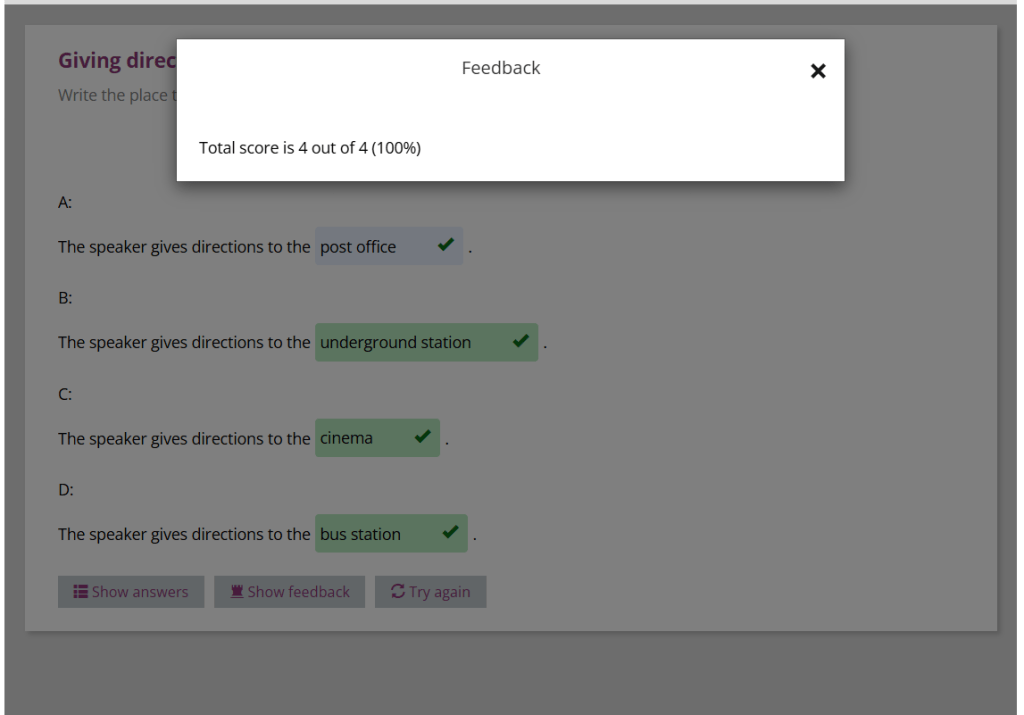
A Go straight on. Then take the first left on to Green Street. Walk past the library and it’s the building next to the library on the left.
B Go straight on. Go past the traffic lights. You will see a shop on the right. Go past that and it’s on the right next to the shop.
C Go straight on. Go past the traffic lights and go straight on until you get to the roundabout. At the roundabout turn left. Go past the theatre. It’s the building next to the theatre, opposite the hospital.
D Go straight on. Go past the traffic lights and take the second right on to King’s Road. Go past the bookshop. It’s the building next to the bookshop opposite the cafe.
Are you humorous? Yes I am humorous, but not often.
Can you tell about a time when you were very funny? I am funny when, I am winning more stronger chess player than me or when I am do chess and mor.
What kind of humor do you like? Do you like many kinds? I like humors in every kind, but not like embarasing humors.
Why do people say laughter is the best medicine? Because laugh is the most funniest thing ever, and when people was laughing they are forgetting about their worries.
Can you tell about a time when you laughed at yourself? No I am don’t laugh at myself, but often I am laughing for nothing and I can’t stop my laugh.
What type of humor do you like? I like simple humors.
Do you like to tell jokes? Yes, every child likes to do jokes.
Are you a good joke teller? Maybe it can say my friends.
What sort of things make you laugh? I can laugh from everything.
How frequently do you laugh every day? Maybe I am laughing every day.
Do you laugh out loud or do you chuckle quietly? I am laughing loud.
Do you sometimes laugh in situations which are not amusing? Yes.
Laughter is catching. Do you start laughing when you see or hear other people laughing? Why do you think this happens? I don’t know but this happens with me very often or every time.
What is the difference between “laughing at someone” and “laughing with someone”? The difference is that if you laugh at, for example to your friend, it’s not good job, but if you laugh at something else,its is different.
Does your language have equivalent expressions for
“I nearly died laughing!” or “I cracked up (with laughter)!”?
“He was the laughing stock”
“Don’t make me laugh!”
Yes I can equivalent that expressions into my language.
«Քիչ էր մնում մեռնեի ծիծաղից»: կամ «Ես մի կերպ պահեցի (ծիծաղս)»: –
Think about your New Year’s resolutions and your happiest memories of the past year. Consider short-term and long-term goals and think about the paths you can take to make your dreams come true. How can you improve your life in the new year? If you could have a New Year’s wish, what would it be? What are you the most excited for in the coming year? If you could celebrate the new year from anywhere in the world, where would you go? Why?
History of New Year Celebrations Around the World
What is New Year’s Eve? New Year’s Eve is one of the biggest occasions in the calendar year for most places in the world, which means there’s a fascinating history surrounding how it’s celebrated, stretching back to the start of recorded history.
There are also multiple ways people celebrate the new year, whether it be fireworks in a city through our modern-day era or Spain’s tradition for people to stay at home, at least until 12 o’clock, and they like to see in the New Year by eating 12 grapes at the stroke of midnight. No matter the way of celebrating the new year, there is something different, but also something unique about it.
Ancient Babylon
The Babylonians were the first people to celebrate New Year in some shape or form. We don’t know a lot about what they did, but maybe they had a big party at the Hanging Gardens of Babylon?
The earliest record of a New Year’s celebration comes over 4,000 years ago from the ancient Babylonians. They didn’t celebrate New Year at the same time we do, though. Instead, the New Year was marked by a big celebration at the spring equinox. To the rest of us, that’s the point of the year when the days start to become longer than the nights. Because they lived in the Northern Hemisphere, this was usually some point in late March.
The Babylonians knew how to party. In fact, they celebrated the New Year with an 11-day festival, which involved a different ritual on each day. Not too much is known about this, but what we do know is pretty exciting. The festival was called Akitu, and it celebrated a victory of the sky god, Marduk, over the evil sea goddess, Tiamat.
The Romans
The Romans were the first people to celebrate New Year’s Day on 1st January, thanks to a certain Julius Caesar.
Though we might think of the Romans as belonging to ancient history, they cropped up a whopping 1,500 years after the earliest traces of Babylonia! Anyway, they loved a good New Year’s party too. They were also the first people to celebrate New Year’s Day when we do, on 1st January.
There’s a good reason for this. The Roman calendar was originally aligned with the sun, but over time, it fell out of sync. So, to bring it back up to speed, Caesar added 90 days! This is the equivalent of roughly two extra months. As part of this, it was decided that each year would start at the beginning of Janus, after the god of new beginnings.
The Middle Ages
The start of the New Year changed again in the Middle Ages, but it didn’t stay like this for long.
In Christian, medieval Europe, the leaders of the Church didn’t like the idea of the New Year being celebrated on a Roman feast day, so they played around with the dates a little. At first, they changed the start of the year to the 25th of December, and then, deciding that Christmas is best left alone, to the 25th of March. Eventually, Pope Gregory XIII realised that there was nothing wrong with the old way of celebrating New Year, so he changed the date back to the 1st of January, in 1582.
And there you have it, a short history of New Year celebrations around the world! If you’d like to learn more about how the big day is celebrated in the 21st century, then you might want to keep on reading…
New Year Celebrations Around the World Today
Spain
Spain has the tastiest way to celebrate New Year’s Eve, that is if you like grapes!
In Spain and a few other Spanish-speaking countries, New Year’s Eve is known as Noche Vieja. It’s traditional for people to stay at home, at least until 12 o’clock, and they like to see in the New Year by eating 12 grapes at the stroke of midnight. This symbolises their hopes and dreams for the year to come. It also sounds pretty tasty too… There are big parties in a lot of towns across the country, but the most famous one is in Madrid, in the Puerta del Sol.
Italy
Over in Italy, New Year’s Eve is known as La Festa di San Silvestro, that is, the feast day of Saint Sylvestre. Like a lot of countries around the world, families gather for a meal, which usually features pork and lentils. After the meal, it’s time to head to the streets for a big ol’ party. If you’re lucky enough to find yourself in a big city like Rome, Milan or Naples, then you can expect to see a big fireworks show.
Oh, and don’t forget to wear red underwear! Some people in Italy believe that wearing red underwear on New Year’s Eve can bring you good luck. You’ll see loads for sale at the December markets!
USA
Times Square is home to what’s probably the world’s most famous New Year’s Eve party.
In the US, New Year’s Eve is celebrated in much the same way as it is here in Australia. That is, families get together for a special meal, and there’s a whole load of fireworks. New York is home to the world’s most famous New Year’s celebration. Each year, thousands of party-goers gather in Manhattan to see the famous Times Square Ball (pictured above) being lowered at the stroke of midnight. The ball itself is made of Waterford Crystal, which is a kind of patterned glass, so let’s hope no one ever drops it!
China
In China, and a few other countries in South East Asia, New Year is celebrated at the start of the lunar calendar, which, in 2022, falls on the 1st of February. The festival lasts for over two weeks, ending with the traditional Lantern Festival. Because there are big Chinese and Asian communities in a lot of countries around the world, most cities will have some kind of Chinese New Year celebration, so you don’t have to worry about missing out on the fun.
Do you always agree with your best friend? Do you ever argue?
Amy normally hated Monday mornings, but this term had been different. Kamal was in her art class and she really liked Kamal. She was waiting outside the art class when her friend Tara arrived.
“Hi Amy! Your mum texted me. You forgot your inhaler and your phone’s switched off again!” Amy wasn’t good with technology. She never sent text messages and she didn’t have a Facebook account either.
“So, did he ask you to the disco then?” Amy wished she hadn’t told Tara about her feelings for Kamal. Tara was Amy’s best friend and she thought that gave her the right to know everything about Amy’s life. “I don’t think he’s interested,” said Amy. “Anyway, you can never see him on his own. He’s always with Grant.” Neither of them liked Grant.
“Have you heard about their art project?” asked Amy. “Yes, it’s something to do with graffiti, I think,” said Tara. “They’ve been working on it at that abandoned house behind the factory.” “But isn’t that really dangerous?” asked Amy. “Aah, are you worried your boyfriend’s going to get hurt?” Tara teased. “Shut up! Hey look, here they come now!”
Kamal and Grant walked over, whispering to each other. “Hi Kamal!” said Tara, ignoring Grant. “Are you going to the Halloween disco tomorrow?” “Maybe. Hi Amy,” Kamal said, smiling. “Do you want to come up to the house and see our graffiti project after school?” Tara elbowed Amy. “I’m coming too!” she insisted.
After school that day, Kamal took the girls to the abandoned house. No one had lived there for years. There was rubbish everywhere. The windows were broken and there was mould on the walls. It was creepy and Amy didn’t like it. The boys had cleared the rubbish out of one room and the walls were covered in paintings of zombies and skeletons. “We’re going to take photos and enter them in the school competition,” said Kamal proudly. Amy didn’t seem impressed. “Very nice,” she said sarcastically. “Where’s Grant?” asked Tara. “Er, he’s gone to buy paint.” Kamal looked away quickly. “Aaah, have you two had a fight, then?” Tara jeered. “It’s getting dark,” said Amy. “Can we go now?” She had had enough of zombies for one day.
Just then, they heard a loud groaning noise coming from a cupboard in the corner of the room. “What was that?” Amy looked frightened. “I didn’t hear anything,” said Kamal. Something started banging against the door and moaning in a low voice. Someone or something was behind the door. “Oh no! What is it?” Amy was trembling now. “What are you talking about? There’s nothing!” Kamal was trying not to smile when the door suddenly burst open and a horrible, bloodstained zombie appeared, moaning and waving its arms. Amy screamed and covered her eyes. “Oh, very funny, Grant!” said Tara, looking bored. Kamal and Grant started giggling. “Ha ha, I scared you!” Grant laughed, very happy with himself. Tara turned to Amy to suggest leaving and noticed her friend was having trouble breathing. Kamal looked worried now. “Is she OK? We were only joking.” “No she’s not OK, you idiot. She’s having an asthma attack and she hasn’t got her inhaler.” Tara took out her phone. “I’m calling her dad.”
The next evening was Halloween. The girls were at the school disco. “Are you sure you’re OK now?” asked Tara. “I’m fine,” said Amy. “It wasn’t a serious attack. I think it was the paint fumes that started it.” Tara looked around. “So, where are the zombies?” “Who cares?” Amy said. “I don’t want to see Kamal again. Come on, let’s dance!”
Amy and Tara were having a great time when Grant arrived, looking worried. “Hi, my phone has been stolen. Have you seen Kamal? He told me to meet him here. Can you phone him?” “Get lost, idiot!” Tara turned away and didn’t stop dancing. Grant looked hurt. “Tell him I’m looking for him if you see him,” he called as he left. Tara really didn’t like Grant.
Just then Tara’s phone beeped and she looked at the screen. “Ha!” she said, “I don’t believe it!” “What?” Amy asked. “Kamal just sent a text. Listen to this!” Tara read Kamal’s text.
“I’m at the house. I’m trapped. Please help. My battery is running out. Call an ambulance.”
The girls continued dancing. Lots of their friends had seen Kamal’s text too, but Tara told everyone to ignore it. It was just another one of his jokes.
The next morning, Amy’s mum and dad were listening to the news on the radio while they were having breakfast. “Is Amy up yet?” Dad asked. “No, today’s a holiday and she didn’t get back home from the disco until midnight,” said Mum, turning the volume up on the radio.
“This morning, police are asking if anyone has information about the tragic death of a sixteen-year-old schoolboy last night in an abandoned house on Moortown Road…”
Dad put down his newspaper and looked at the radio. “But that’s where Amy went with her friends on Monday.”
“…The boy, who died from loss of blood, was discovered early this morning partly buried under a pile of rubble and has been identified as Kamal Naseer…”






 Արեն Մնացականյան