

2. don’t have to
3. don’t have to
4. mustn’t
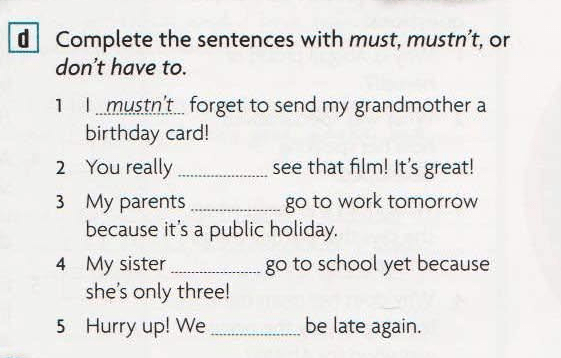
2. must
3. mustn’t
4. mustn’t
5. mustn’t
Արեն Մնացականյան Միջին դպրոց 9.5
2. don’t have to
3. don’t have to
4. mustn’t
2. must
3. mustn’t
4. mustn’t
5. mustn’t
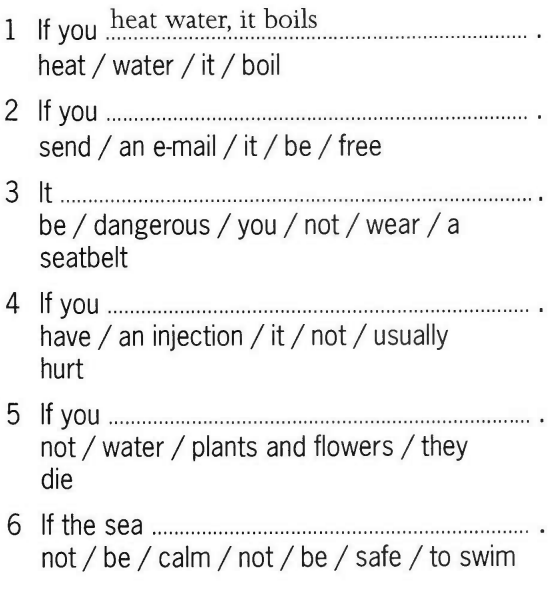
2. Send an e-mail it is free.
3. It will be dangerous if you want wear a seatbelt.
4.If you will have an injection it isn’t usually hurt.
5. If you isn’t water plants and flowers they die.
6.If the sea isn’t calm it isn’t safe to swim.
Chinese New Year is the celebration of the New Year in Chinese communities around the world. The date of the Chinese New Year is determined by the lunar calendar, so festivities begin with the new cycle of the moon that falls between January 21 and February 19. Each year is named for one of 12 symbolic animals in sequence. The animals are: the rat, ox, tiger, hare, dragon, serpent, horse, ram, monkey, rooster, dog and boar. The New Year celebration is the most important and the longest of all Chinese festivals, traditionally lasting for two weeks. During the period, towns and villages are decorated with colored lanterns, floral exhibitions, and brightly colored banners with New Year greetings. Preparations traditionally began in the home the week before the New Year, when families thoroughly clean their houses to symbolically sweep away all traces of misfortune. They also pay of debts, add a new coat of red paint to doors and windowpanes, and decorate the home with flowers. To avoid bad luck, parents warn their children to be on their best behaviour. On the evening before the New Year, families gather for a feast of various dishes of seafood and dumplings. Each dish has symbolic meaning, often signifying good luck and prosperity. At midnight, families light fireworks to attract the attention of benevolent god and to frighten away evils spirits. The fireworks last until dawn, although celebrants may light more fireworks for the next two weeks.
2. When do festivities begin? The festivities begin from January 21 to February 19.
3. Why do families light fireworks? Because they think that firework will attract the attention of god and frighten away evils spirits.
4. The word various is synonymous to many.
2. Write the verbs in the right tense form.
After I had lunch at a village inn, I (1) looked for my bag. (to look) (2). I left it on the chair beside the door but it wasn’t there! (to leave). As I (3) was looking for it, the inn-keeper came in. (to look for)
“Did you have a good meal?” he asked.
“Yes, thank you. ” I answered, ” but I can’t pay the bill. I haven’t got my bag. “
The inn-keeper (4) smiled and immediately went out. (to smile). in a few minutes he returned with my bag and (5) gave it back to me. (to give)
“I am sorry, ” he said. My dog had taken in into the garden. He often does this”.
3. Translate the sentences form Armenian into English.
Chinese New Year is the celebration of the New Year in Chinese communities around the world. The date of the Chinese New Year is determined by the lunar calendar, so festivities begin with the new cycle of the moon that falls between January 21 and February 19. Each year is named for one of 12 symbolic animals in sequence. The animals are: the rat, ox, tiger, hare, dragon, serpent, horse, ram, monkey, rooster, dog and boar. The New Year celebration is the most important and the longest of all Chinese festivals, traditionally lasting for two weeks. During the period, towns and villages are decorated with colored lanterns, floral exhibitions, and brightly colored banners with New Year greetings. Preparations traditionally began in the home the week before the New Year, when families thoroughly clean their houses to symbolically sweep away all traces of misfortune. They also pay of debts, add a new coat of red paint to doors and windowpanes, and decorate the home with flowers. To avoid bad luck, parents warn their children to be on their best behaviour. On the evening before the New Year, families gather for a feast of various dishes of seafood and dumplings. Each dish has symbolic meaning, often signifying good luck and prosperity. At midnight, families light fireworks to attract the attention of benevolent god and to frighten away evils spirits. The fireworks last until dawn, although celebrants may light more fireworks for the next two weeks.
2. When do festivities begin?
3. Why do families light fireworks?
4. The word various is synonymous to ...
2. Write the verbs in the right tense form.
After I had lunch at a village inn, I (1) … for my bag. (to look) (2). I … it on the chair beside the door but it wasn’t there! (to leave). As I (3) … it, the inn-keeper came in. (to look for)
“Did you have a good meal?” he asked.
“Yes, thank you. ” I answered, ” but I can’t pay the bill. I haven’t got my bag. “
The inn-keeper (4) … and immediately went out. (to smile). in a few minutes he returned with my bag and (5) … it back to me. (to give)
“I am sorry, ” he said. My dog had taken in into the garden. He often does this”.
3. Translate the sentences form Armenian into English.
4. Speak on the following topic.
| 1) Somebody found the key. [ . ] | The key was found by somebody. |
| 2) Somebody made mistakes. [ . ] | The mistakes were made by somebody |
| 3) Somebody loved that woman. [ . ] | That woman was loved by somebody. |
| 4) Somebody cleaned the rooms. [ . ] | The rooms were cleaned by somebody. |
| 5) Somebody fixed the computer. [ . ] | The computer was fixed by somebody. |
| 6) Somebody built that house. [ . ] | That house was built by somebody. |
| 7) Somebody wrote War and Peace. [ . ] | The War and peace was written by somebody. |
| 8) Somebody painted The Mona Lisa. [ . ] | The Mona Lisa was painted by somebody. |
| 9) Somebody stole my wallet. [ . ] | The somebody was stolen my wallet. |
| 10) Somebody prepared lunch. [ . ] | Lunch was prepared by somebody. |
| 11) Somebody drank a lot of coffee. [ . ] | A lot of coffee was drank by somebody. |
| 12) Somebody forgot the papers. [ . ] | The papers were forgotten by somebody. |
| 13) Somebody closed the windows. [ . ] | Windows were closed by somebody. |
| 14) Somebody invited Julie and Luke to a party. [ . ] | Julie and Luke were invited to a party by somebody. |
| 15) Somebody built a website. [ . ] | The Website was built by somebody |
| 16) Somebody ate all the cakes. [ . ] | All the cakes were eaten by somebody. |
| 17) Somebody told me to wait. [ . ] | I was told to wait by somebody. |
| 18) Somebody employed a lot of new waiters. [ . ] | A lot of new waiters was employed by somebody. |
| 19) Somebody opened a shop. [ . ] | A shop was opened by somebody. |
| 20) Somebody lost the letter. [ . ] | The letter was lost by somebody. |
Valerie studies at a big university. At the same time, she maintains a full-time job so that she can pay for her tuition and her living expenses. So Valerie spends most of the day at the office, then goes to class three days a week. She also stays up late at night to study for her classes.
Valerie does not do any physical exercise. Between work and university, she is so busy that she thinks she does not have time for any physical activity.
Sadly, she rarely eats home-made meals. She usually just grabs a bag of chips or a hamburger as she leaves her office to take the bus to university. Since she is convinced that she does not have time to make a healthy dinner when she gets home, she eats lots of pizzas that she orders over the phone.
After dinner, she starts studying and preparing her assignments. Valerie does not sleep very much because of it. She feels grumpy when she wakes up early in the morning, and she is irritable at work. After her long day, she feels tired in class, and it is hard for her to concentrate.
To make matters even worse, Valerie keeps getting sick. This makes her miss work and class. She is miserable! She just wants to feel good. Her grades start to go down because of her illnesses. As she thinks about her whole life situation, she gets so frustrated that she does not even want to study anymore.
During her mid-year break, Valerie decides to make some big changes. First, she learns how to make some easy, healthy recipes. She actually finds that she saves a lot of money by preparing her food herself, and the food tastes much better too! After an early dinner and some quiet reading, Valerie goes to bed early every night. Now she really feels refreshed in the morning.
Then she decides to give something else a try. Her office is not really so far from her university, so one day after work she tries walking there. As she walks down the street, looking at all the people, the shops, and the movement in the city, she remembers how much she hates being stuck on the bus in traffic. In fact, she finds that she can get to class almost as fast by walking. And she is so much happier when she arrives!
When the semester begins, Valerie maintains her healthy habits. She sets time aside on the weekends to study and do her assignments. Because she is sleeping and eating better now, she can finally concentrate and needs to spend much less time studying.
It is a huge improvement. Valerie saves money on food and transportation, she has much more energy, she feels less stressed, and her grades are better. She is glad she finally started to take care of herself. Now she finally enjoys all of her different activities and feels happy about her life.
1. What does “tuition” mean?
a) the money you pay to live in an apartment
b) the money someone pays you to work for them
c) the money you pay to a university to study there
d) the money a university gives you to help you study
2. What does “grumpy” mean?
a) upset and irritable
b) confused
c) energetic
d) tired
3. What does “healthy” mean?
a) good for your body
b) good for your emotional state
c) good for your mental state
d) all of the above
1. She decides ________ to class.
a) to walk
b) walking
c) walk
d) walked
2. Valerie keeps ________ sick.
a) having
b) getting
c) being
d) doing
3. She is so much ________ when she arrives.
a) happy
b) happiest
c) more happy
d) happier
1. Why does Valerie always feel frustrated and irritable? Because she was sick, and she did not go to her classes and her marks fall.
2. What healthy changes does Valerie make in her life? She improved her food, she gave up ordering fast food and she began doing exercises.
Famous Women in History
In this lesson, students choose a woman they feel contributed something important to society and then create a presentation about her and the contribution. A variety of choices are offered …
Test
Choose from the following prepositions at, by, for, from, in, on, with and complete the sentences.
Use the verbs in brackets to complete the sentences. Use the correct tense.
When I was looking out of the window, I saw John. Have you ever played the piano since you left school? I have not seen him for two days. When he was trying to open the door, he dropped his key. They have lived in this house since 1987. My father was washing his car while my mother and I were preparing dinner. Did you meet her yesterday? Mary has been in London for three days. The headmaster entered the classroom when they were writing their exams. He bought a new car last week. I think that they will arrive tomorrow morning. Last Wednesday they played chess after they had done their homework.
Choose the correct pronouns to complete the sentences.
1. The old woman lived alone, with —- to look after —-.
A) someone / her
B) anyone / herself
C) everyone / she
D) no one / her
E) anyone / she’s
2. —- two rings here on my little finger belonged to —- grandmother.
A) These / my
B) That / mine
C) Those / me
D) The / myself
E) This / my
3. When the little boy grabbed the lizard, —- tail broke off in —- hand.
A) it’s / his
B) it / him
C) its / his
D) it / one’s
E) its / he’s
4. A baby learns the meaning of words as —- are spoken by others and later uses —- in sentences.
A) their / they
B) they / them
C) they / themselves
D) it / them
E) they / it
5. Some of these clothes are —-, and the rest of —- belong to Zack.
A) yours / it
B) my / them
C) hers / their
D) me / they
E) mine / them
6. As for —-, I prefer to let people make up —- minds.
A) myself / each other’s
B) I / his own
C) mine / one another’s
D) me / their own
E) my / theirs
7. The solicitor wrote a letter to Ann and —- in which he asked us if we could settle the matter between —-.
A) I / us
B) me / us
C) myself / ours
D) mine / our
E) me / we
8. As —- cuts it as well as he does, I always have my hair cut at Johnson’s.
A) anyone
B) someone else’s
C) no one else
D) everyone
E) nobody’s
9. They decided to buy the house because —- location would allow —- to get to work very easily.
A) theirs / them
B) it / themselves
C) its / them
D) they / us
E) its / their
10. Our dog is of a very good breed as —- is the offspring of two very champion dogs and inherited —- features.
A) this / its
B) he / them
C) she / theirs
D) that / his
E) it / their
Complete the following exercise with adjective or adverb form of the words.
That pitbull looks angrily. (angry) She spoke quietly. (quiet) Erica listened to her mother carefully. (careful) Mary makes careless mistakes. (careless) Children grow quickly. (quick) He is very happy today. (happy) It’s raining heavily. (heavy) Morgan was seriously hurt in a car accident. (serious) His situation was very serious. (serious)

The underwater hotel called “Lovers Deep” can be moored near the coastal reef off the coast of St. Lucia or near a sunken battleship in the Red Sea.
But love at the bottom of the ocean doesn’t come cheap. You’ll need to cough up £175,000 per night in order to board the submarine vessel.

Guests get a captain, a private chef and butler, speedboat transfers and optional add-ons that include helicopter transfers, beach landing, two-person shower, and champagne-soaked breakfast.

by Donald Bisset
Once upon a time there was a river which was made of words. It flowed (հոսում էր) down to the sea and the sea was made of story books.

As the river flowed along, the words and the letters tumbled over each (գլուխկոնծի էին տալիս) other and hit the rocks just like ordinary rivers.
“I know,” said the river. “Let’s write a story! Once upon a time…”
“Hooray!” shouted all the other words. “That’s the way to begin a story. Now what comes next?”
This is the story the river told them.
Once upon a time there was a river made of words and it was going down to the sea and all the words were going into story books, when suddenly a little otter (ջրասամույր) swam across the river and the words got into the wrong order so that instead of writing “Once upon a time’ it wrote “on at Once up time” and it got in a frightful muddle.
“Oh, you are a naughty otter,” the river said to the otter whose name was Charlie. “Now you’ve spoilt our story.”
“I’m terribly sorry!” said Charlie. “Perhaps if I swim back again it’ll put things right.”
He swam back and then clambered on the bank and looked at the words, “time upon a Once”, he read. “Surely that’s not right!”
However the river swirled about a bit and soon got it right. “Once upon a time,” he read, “there was an otter who is name was Charlie.”

“Why that’s me! My name’s Charlie. It’s a story about me!” He got so excited and jumped up and down and then slipped and fell in the river and jumbled up the words again. Oh, the river was annoyed!
The otter got out as quickly as he could and looked at the words: “otter was Charlie time upon a Once.” Worse and worse!
“What do you expect?” said the river. “Every time we start you fall in and get it all jumbled. Now we’ve got to start all over again.”
“Once upon a time there was an otter whose name was Charlie and he lived by the river of words… Now what happens next?“
They thought and thought but couldn’t think of a story about Charlie. So he said, “I’ll help,” and got back from the river and then ran as fast as he could and jumped right into the middle of the river. Then he swam and looked at the words. (He’d jumbled them right, this time.)
“Once upon a time there was a very naughty otter,” he read, “and one day he met a pussy-cat.”
“Mieow!” said the pussycat. “Do you like ice-cream?”
“No!” said Charlie.
“Mieow! Do you like milk?”
“No!”
“Mieow! Do you like fish?”
“Yes, I do!” said Charlie.
“Mieow,” said the pussycat. “Well, if you come to my house my aunt will give you a fish tea. Brown bread and butter and fish paste.”
“That will be nice!” said Charlie. “It makes me feel quite hungry. I think I’ll go home to tea now. But before I go tell me, what are you going to do with the story?”
“It’s going to be a story in a book called Time and Again Stories,” said the river.
Charlie was pleased. “That’s nice!” he said. “Now I’m going! Good-bye!”
“Good-bye!” said the river.
The words all jumbled around and then spelt “Love and kisses to Charlie.” And tumbling and tossing they flowed on into the storybook sea
Unknown words
flow down- ներքև հոսել
flow along-երկայնքով հոսել
to tumble-գլորվել, գլուխկոնծի տալ
to shout- բղավել
to shut- փակել
otter-ջրասամույր
to be pleased- գոհ լինել
naughty-չարաճճի
frightful-սարսափելի
muddle-խառնաշփոթ
 Արեն Մնացականյան